

Here you'll find links to manufacturers of special-purpose solar viewers and filters that you can be confident are safe when used properly. These include companies with which members of the AAS Solar Eclipse Task Force have had good experiences as well as other companies that have demonstrated to our satisfaction that the products they're manufacturing conform to the ISO 12312-2 international standard for filters for the direct observation of the Sun. Some companies are based in North America, some in Europe, and some in China; we make no distinction in our list, but be aware that not all companies will ship their products to all countries.
Companies are listed alphabetically by name; the order of the listings does not imply any preference. Manufacturers: To request inclusion on this page, first read the article "How to Get Onto Our List of Manufacturers of Safe Solar Viewers & Filters," then email us.
 Note: This is no longer the sole list of vetted suppliers of safe solar viewers! Volunteer Astronomy Observers of Spain (OVAE) is vetting suppliers on their website at Eclipse Seguro (Eclipse Safety), mainly for the benefit of citizens and visitors planning to observe the August 2026 and August 2027 total solar eclipses in Spain. If you're buying solar viewers in Europe, have a look at the Eclipse Seguro suppliers list, keeping in mind that the AAS is not supervising or otherwised involved with OVAE's vetting process and assumes no responsibility for it.
Recommendations & More Information
Before the "Great American" solar eclipses of 2017, 2023, and 2024, we listed not only the relatively small number of manufacturers of solar viewers and filters but also a huge number of wholesalers, distributors, retailers, and online resellers of these products. Vetting all these suppliers became an overwhelming burden, and the AAS cannot support it any longer — though we will do our best to keep our list of manufacturers up to date. Accordingly, we offer the following recommendations:
- Manufacturers should publish their own lists of authorized resellers, including wholesalers, distributors, and retailers. This would reduce the burden on external organizations while maintaining accountability.
- Consumers should buy solar viewers directly from known manufacturers or any authorized dealers those manufacturers publicly identify.
- Buying solar viewers from online marketplaces, local shops, or other retailers who may not know anything about solar eclipses and are simply "cashing in” on a solar eclipse is not worth the risk to your eyes.
For more information about how the AAS Solar Eclipse Task Force vetted solar viewing devices for the "Great American" solar eclipses, see the free online article "Ensuring the Safety of Eclipse Glasses and Handheld Solar Viewers in the Bulletin of the AAS, Volume 57, Issue 6 (2025).
For instructions on how to observe the Sun safely, see our main safety page and our pages on pinhole and optical projection and viewing through optics.
Eclipse Glasses & Handheld Solar Viewers | Solar Filters for Optics | Solar Filters for Smartphones | Solar Optical Projectors
Manufacturers of Eclipse Glasses, Handheld Solar Viewers & Solar Filter Sheets/Rolls
The following companies manufacture their own solar-filter material in sheets and/or rolls and/or use one of the other companies' films to manufacture their own branded eclipse glasses, clip-on solar viewers, handheld solar viewers, and/or other filters for direct viewing of the Sun's bright face. Some sell only wholesale to distributors and/or resellers, while others sell to retail customers; some sell via multiple channels. Some of these companies offer custom printing to buyers making bulk purchases.
- Absolute Eclipse (Gravitis Enterprise Limited)
- American Paper Optics / eclipseglasses.com / Eclipser
- Baader Planetarium/AstroSolar
- Bookishbunny
- Cangnan County Qiwei Craft Co., Ltd.
- Celestech
- DayStar Filters
- Celestial Optical (EclipseGuard glasses | SolarShield sheets)
- EclipseSpecs (North American sales only)
- Flip'n Shades (clip-ons for baseball caps)
- Grafix Plastics (sheets & rolls, wholesale only)
- Halo Eclipse Spectacles
- Hangzhou Retsing Eyewear Co., Ltd. (wholesale only)
- Jaxy Optical Instruments Co., Ltd. (wholesale only)
- Lunt Solar Systems / TSE17
- ORRO
- Rainbow Symphony / Eclipse Shades
- Seymour Solar (Hyperion sheets)
- Shenzhen Lionstar Technology Co., Ltd. (wholesale only)
- Shenzhen Shihui Tongda Technology Co., Ltd. (selling both wholesale and retail [direct to consumers] and shipping from North American warehouses)
- Solar Optics Group (Exclipse / SolarOptics)
- SolarWear by American PaperWear (Solar Rollens viewers)
- Sollunae (U.K. sales only)
- Tember Solar Eclipse Glasses (Rezos LLC)
- Thousand Oaks Optical (a division of ZWO)
Other Sources of Solar Viewers
What if you received eclipse glasses or a handheld solar viewer from a relative, friend, neighbor, or acquaintance? If that person is an amateur or professional astronomer, they're probably OK, because astronomers get their solar filters from sources they know and trust (for example, the manufacturers listed above or their authorized resellers). Ditto for professional astronomical organizations (including college and university physics and astronomy departments) and amateur-astronomy clubs.
If you bought or were given eclipse viewers at a science museum or planetarium, or at an astronomy trade show, again you're almost certainly in possession of safe products. As long as you can trace your filters to a manufacturer listed above, you have nothing to worry about. What you absolutely should not do is search for eclipse glasses or other solar viewers on the internet and buy whatever pops up in the ads or search results!
Suppliers of Solar Filters for Telescopes, Binoculars & Camera Lenses
The ISO 12312-2 international standard does not apply to solar filters for optics, but such filters may be considered safe as long as they conform to ISO 12312-2's requirements for transmittance, uniformity of transmittance, and material and surface quality and as long as they are mounted securely over the front of the optics and used according to the supplier's instructions.
The following of list includes a mix of manufacturers and authorized resellers of solar filters for optics. As above, companies are listed alphabetically by name; the order of the listings does not imply any preference. These are specialty retailers with staff who are knowledgeable about astronomy in general and solar observing and photography in particular. These are the companies that amateur and professional astronomers turn to when they need solar filters for their camera lenses, binoculars, or telescopes.
Solar filters for optics must be mounted securely over the aperture, i.e., front opening, and should be used only by experienced observers. Be sure to read our safety tips before using solar filters with optics!
- Agena Astro
- All-Star Telescope
- Alpine Astronomical (Filter Sheets / Mounted Filters)
- APM Telescopes
- Astronomics
- Astronomy Plus
- Astro-Physics, Inc.
- AstroSolar
- Astrozap
- B&H Photo & Video
- Baader Planetarium
- Celestial Optical Sundara Lens Filters
- Celestron
- Datyson / Shengzhen Datyson Trading Company Ltd.
- DayStar Filters
- East Fox Studio
- Explore Scientific
- Galileo Optics
- High Point Scientific
- ICSTARS Astronomy
- Khan Scope
- Kendrick Astro Instruments
- Kosmos Scientific
- Marumi Lens Filters / Argraph Division, Unique Photo
- Mile High Astronomy
- NiSi Lens Filters
- Ontario Telescopes & Accessories
- Rainbow Symphony
- Seymour Solar
- Spectrum Telescope
- Svbony Optics
- Telescopes Canada
- Thousand Oaks Optical (a division of ZWO)
- Woodland Hills Camera & Telescope
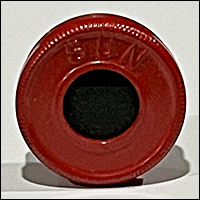 Warning: Solar filters designed to thread into an eyepiece at the back end of the telescope — where you put your eye — are dangerous; sunlight concentrated by your optics could destroy it and injure your eye in a flash — literally. If you have such a filter, such as the example shown at right, discard it. We'll say it again: A solar filter must be attached securely to the front of your telescope, binoculars, or camera lens.
To find telescopes and binoculars specially made for observing the Sun, see the Special-Purpose Solar Binoculars & Telescopes section of our Telescopes & Binoculars page.
Solar Filters for Smartphones
The following products include safe solar filters and Velcro or other fasteners that enable you to temporarily secure a filter over the lens(es) of your smartphone camera.
- Solar Snap (Doug Duncan & American Paper Optics; made in the U.S.)
- This is the first such product to appear on the market. Using the accompanying Solar Snap app, which is available for free in versions for iPhones and Android phones, you can easily choose appropriate exposure settings to shoot photos of the uneclipsed or partially eclipsed Sun through the included solar filter. You can use the app to capture images of the totally eclipsed Sun, too, but you'll need to remove the filter during totality or your images will be blank.
- SafeShot (Grafix Arts / Grafix Plastics; made in the U.S.)
- Made of heavy-duty cardboard, this product has two solar filters: a dark visual filter that you can look through and a lighter filter for your smartphone's camera; this means you can take pictures and view the Sun at the same time. Instructions on the SafeShot website explain how to use your phone's native camera app or a third-party camera app to dial in the appropriate exposure settings. Thanks to the light photographic filter, you should be able to capture images of the inner corona during totality without having to detach your smartphone from the device.
Solar Optical Projectors
The following devices are used for indirect solar observation. They use lenses and mirrors to project an image of the Sun onto a white surface. In other words, you don't look through them — you look at them. Be sure to read our safety tips before using a solar optical projector!
- Sunspotter (Science First)
- Solarscope (Solarscope USA)
- Build-It-Yourself Safe Solar Viewer (T. R. Richardson, College of Charleston, SC)
And check out the Sun Funnel, an inexpensive do-it-yourself projection device that works with a small telescope to provide a safe solar viewing experience for groups. Download a free PDF with detailed instructions for making and using one.